
The Incredible Rise of Gold Prices Over the Last Year
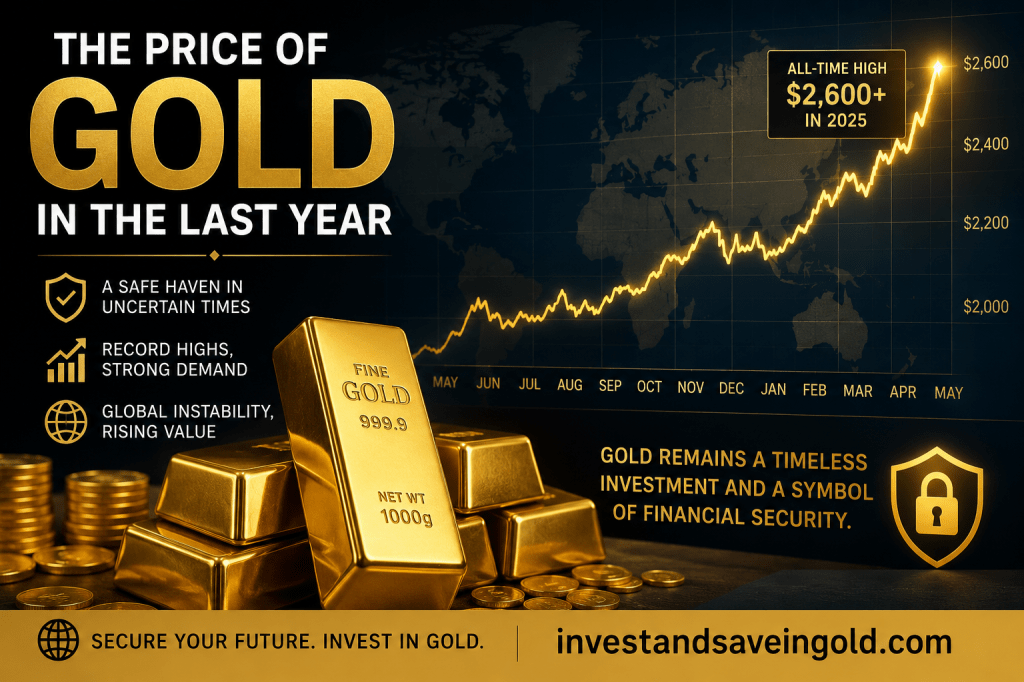
Over the past year, gold prices have captured global attention as investors, governments, and financial institutions rushed toward the traditional safe-haven asset. What started as a cautious rally quickly transformed into one of the strongest gold bull runs in modern market history. The precious metal repeatedly broke records, reflecting the uncertainty and tension shaping the global economy.
One of the biggest reasons behind the rise in gold prices was geopolitical instability. Conflicts in the Middle East, trade disputes between major economies, and concerns about global economic slowdowns pushed investors toward safer investments. Whenever uncertainty grows, gold tends to shine because it is viewed as a store of value that can survive economic shocks.
Another major driver was inflation. Although inflation rates slowed in some countries compared to previous years, prices for goods, energy, and services remained elevated. Investors worried that traditional currencies could lose purchasing power over time. Gold historically performs well during inflationary periods because it preserves long-term value better than many paper assets.
Central banks also played a crucial role in pushing prices higher. Throughout the year, many countries continued increasing their gold reserves. Nations such as Poland, China, Turkey, and Brazil expanded their holdings to reduce dependence on the US dollar and strengthen financial stability. According to the World Gold Council, central bank purchases remained historically strong even as gold prices reached record highs.
Investor demand surged across multiple markets. Gold-backed exchange-traded funds (ETFs) saw massive inflows as institutional and retail investors searched for protection against volatility. The World Gold Council reported that ETF holdings climbed sharply during 2025, supported by concerns over global growth and future interest rate decisions.
The weakening US dollar also strengthened gold’s momentum. Since gold is priced in dollars, a weaker dollar makes the metal cheaper and more attractive for international buyers. At the same time, expectations of future interest rate cuts by major central banks increased the appeal of non-yielding assets like gold.
During the first half of 2025 alone, gold prices rose by roughly 26%, making it one of the strongest-performing major assets of the year. Analysts noted that the metal achieved dozens of all-time highs during this period, fueled by intense trading activity and strong investor demand.
However, the gold market was not entirely smooth. Prices occasionally dropped during periods of optimism in global markets or when investors believed tensions might ease. Temporary peace discussions, improving economic data, and stronger bond yields sometimes caused short-term pullbacks. Yet each decline was often followed by renewed buying as uncertainty returned.
Interestingly, gold demand from the jewelry industry weakened in several regions because higher prices made purchases more expensive for consumers. Despite lower physical jewelry demand, investment demand easily compensated for the slowdown. Many investors increasingly viewed gold not as decoration, but as financial insurance.
The digital age also changed how people interacted with gold. Younger investors began purchasing gold through online platforms, ETFs, and digital investment apps instead of traditional coins or bars. Social media discussions and online trading communities further amplified public interest in the precious metal.
Looking ahead, experts remain divided on gold’s future direction. Some analysts believe prices could continue climbing if economic uncertainty persists and central banks maintain strong buying activity. Others argue that easing inflation and stronger economic growth could reduce demand for safe-haven assets. Regardless of short-term fluctuations, gold has once again proven its importance during uncertain times.
The last year demonstrated that gold remains deeply connected to human psychology and global economics. Whenever fear rises, confidence falls, or markets become unstable, investors continue turning to the timeless security of gold. Whether viewed as an investment, a hedge, or a symbol of wealth, gold’s powerful performance over the past year confirms that its role in the global economy is far from fading.

